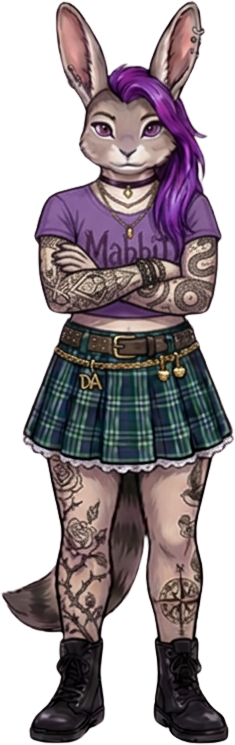
I live in Eugene, Oregon, with my husband, Chace, and three German Shepherds: mom, dad, and daughter. A complete canine family unit, because apparently one German Shepherd was not enough. We needed a dynasty.
Chace and I met on Xbox Live playing Call of Duty about fifteen years ago, which is either a modern love story or proof that something worthwhile can occasionally emerge from a multiplayer lobby. We've been together for most of fourteen years. On Valentine's Day 2024, we got married both legally in real life and inside the world of Fallout. The paperwork was real. So was the wasteland wedding.
I'm also the mother of two grown daughters. Robyn is twenty-one and living a life with enough plot twists to keep things interesting. Maeve is eighteen, newly graduated from high school, and living her best life with her longtime partner, Carter. They are smart, funny, complicated, entirely themselves, and two of the best people I know.
The rest of my character sheet includes raccoons, unicorns, fantasy books, LitRPG, Borderlands, Fallout, hiking, colorful gel pens, and doing most of my best work at hours when respectable people are asleep.
I did not arrive at academia through the tidy, institutionally approved route.
Before becoming a full-time student, I worked in warehouses, retail, gig delivery, and e-commerce. I raised children. I built things, abandoned things, started over, and learned how much knowledge never appears on an official transcript. Now I'm a senior at the University of Oregon studying anthropology with a minor in nonprofit administration. I'm also a freelance researcher whose work has taken me through public records, regulations, correctional facilities, procurement systems, property research, nonprofits, and statistics that looked impressive until somebody asked what the denominator was.
In other words, I came to higher education with a life already in progress.
Once I got here, I discovered that academia runs on two sets of rules: the ones written in the handbook and the ones everybody expects you to know without being told. Office hours. Citation hierarchies. Participation grades. Faculty etiquette. Bureaucratic vocabulary. The thousand tiny customs that get treated as common sense even though they are only common if someone taught them to you.
Deconstructing Academia is what happened when I got tired of pretending that was normal.
I built this project to take academic systems apart, trace the evidence, translate the hidden rules, and ask who benefits when those rules stay hidden. Not because expertise is fake. Not because education is pointless. Because knowledge matters too much to leave it wrapped in institutional fog.
I'm not standing outside academia throwing rocks at it. I'm inside, taking notes.
And I brought receipts.